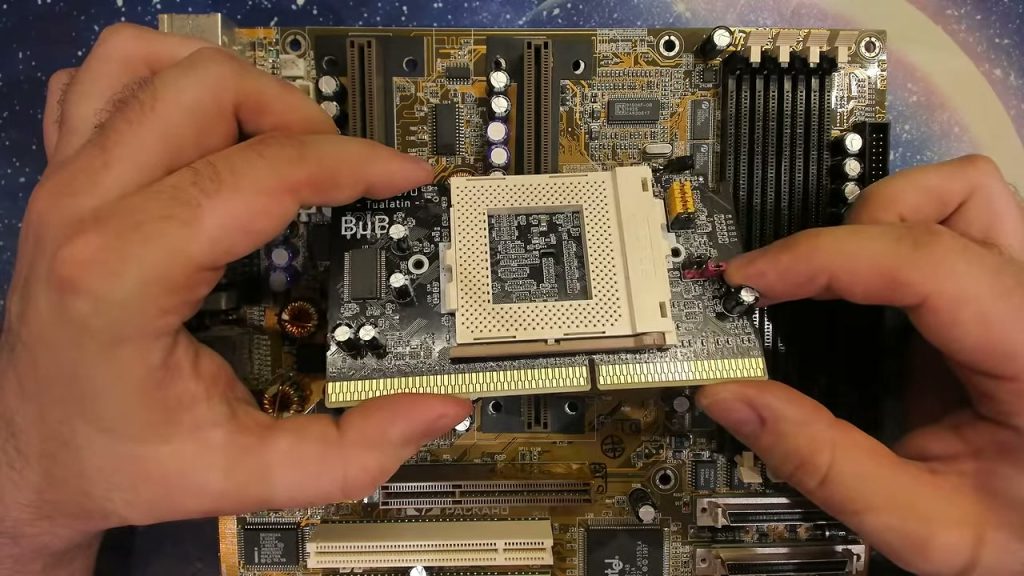
A late-1990s HP server board has gained a more useful BIOS and a lower CPU bus-termination voltage—but the seemingly simpler goal of running it reliably at a 66 MHz front-side bus remains unresolved.
In a video published 5 November 2026, Bits und Bolts works on an HP NetServer E60 motherboard built by ASUS and related to its P2B-DS. The creator says a modified Award BIOS restores useful configuration options and demonstrates the onboard network interface working under Windows XP. The SCSI controller is present in the BIOS, but he explicitly has not tested it with a drive.
The hands-on result is the VTT modification. After tracing the voltage-regulator feedback circuit and adding a resistor, he measures the termination supply at about 1.37 V, down from roughly 1.5 V. That brings it closer to the voltage expected by the Tualatin-era CPU setup he is testing; it is a measured change on this board, not a general endorsement of the modification for every 440BX system.
The setback is just as instructive. A jumper forces 66 MHz operation and the machine reaches DOS, but further testing remains unstable; Tomb Raider crashes. Returning to 100 MHz restores a working demonstration. The video does not establish the cause of the 66 MHz failure, and the creator leaves that question open. For retro-PC builders, the useful distinction is between a successful voltage fix and a still-unproven dual-CPU or low-bus-speed configuration.
Watch the full 25-minute Bits und Bolts video for the regulator tracing, measurements and boot tests.