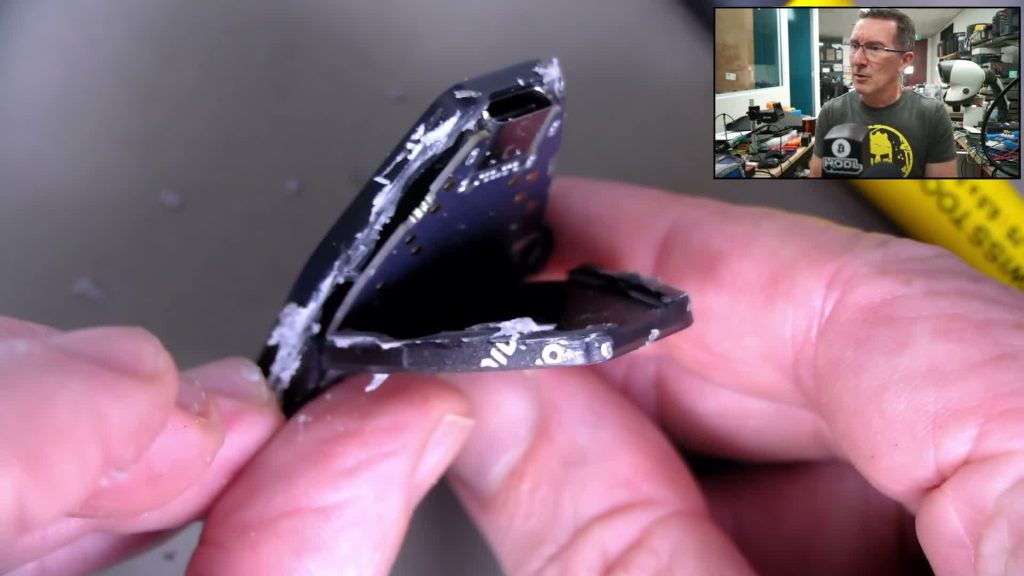
Hardware security and crypto storage solutions face a continuous game of cat-and-mouse against supply chain attackers. In his latest video, Dave Jones of EEVblog takes a detailed, board-level look at the new Trezor Safe 3 hardware wallet, focusing specifically on how it protects against physical manipulation and hardware-level intercept attacks.
The teardown inspection highlights the unit’s mechanical construction and physical security measures, starting with the outer packaging features, anti-tamper holographic stickers, laser-etched branding, and precise weight testing (clocking in at exactly 14.25 grams to verify that no malicious interdiction hardware has been added inside the housing). From there, Dave transitions to a destructive “medieval teardown” to examine the underlying printed circuit board (PCB).
Encrypted I2C and Secure Element Integration
The core architectural highlight of the Safe 3 is its integration of an Infineon Optiga Trust M secure element. While previous hardware designs (including earlier open-source architectures) frequently left internal communication buses exposed to physical probing, the Safe 3 implements a shielded, fully encrypted I2C link between the primary microcontroller and the secure element. This is a critical engineering countermeasure that prevents attackers from simply soldering logic analyzers or bus sniffers to the communication lines to intercept raw secret keys—a common vulnerability on older hardware platforms.
A Contrast in Hardware Philosophies
Throughout the teardown, Dave compares Trezor’s design philosophy with competitor Ledger, emphasizing the open-source hardware approach. By publishing schematics and firmware on GitHub, Trezor allows peer review of the implementation, though the secure element chip itself contains proprietary internal designs. The video also explores Trezor’s approach to “Genuine Authentication” using the Trezor Suite app, verifying that the hardware has not been compromised or replaced prior to reaching the user.
Open vs. Closed Interconnection
While modern high-security consumer platforms like the Trezor Safe 3 rely on deeply specialized secure elements and encrypted communication channels to prevent sniffing, vintage hardware hacking operates on the exact opposite paradigm. Classic homebrew systems thrive on open, fully readable buses where signals are meant to be studied, probed, and manipulated.
For makers and electronics enthusiasts looking to interface with, reprogram, or construct classic 8-bit and vintage microprocessor systems, keeping buses open and simple is part of the joy. To program the non-secure parallel ROMs, EEPROMs, and classic microcontrollers required for retro projects, tools like Anders Nielsen’s Relatively Universal ROM Programmer (RURP) kit offer an excellent, highly accessible programming interface. It serves as a reminder that while encrypted buses are vital for modern security, classic, unshielded electronics are still the best sandbox for understanding raw hardware fundamentals.