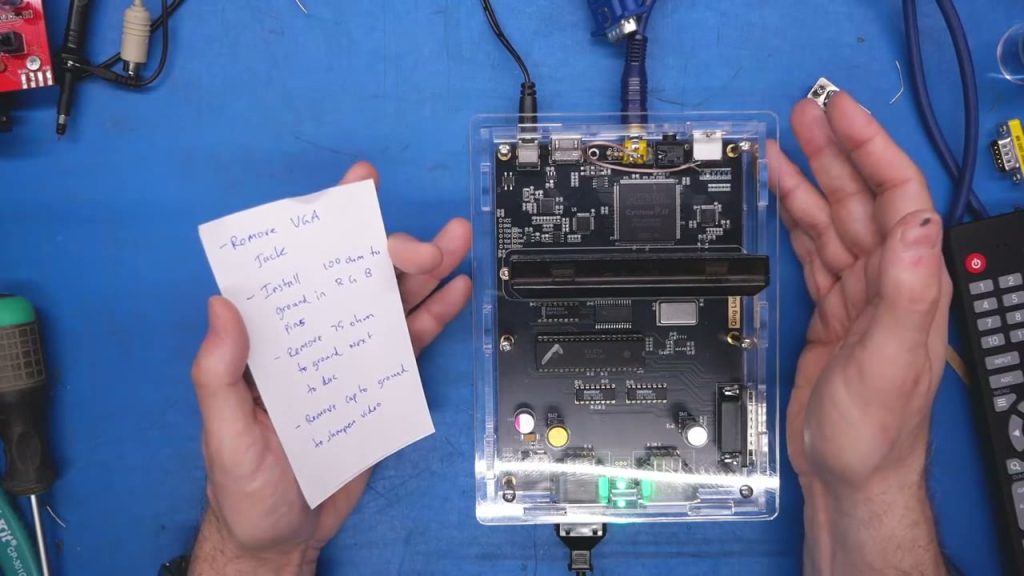
An NES clone with HDMI, VGA, RGB and S-Video sounds like a convenient way to use original cartridges on modern and vintage displays. In a video published on 27 September 2026, Adrian’s Digital Basement puts one such Famicom-style machine through a much more demanding test than its product listing.
Useful features, troublesome output
The 56-minute investigation looks at the console’s cartridge slot, video connections and switches for NTSC, PAL and Dendy-type CPUs. Adrian tries games and compares the picture and sound with other hardware. The VGA picture is notably dark, while HDMI has its own level and scaling issues. The supplied clone CPU also produces audio that Adrian finds wrong in his tests.
Opening the acrylic-cased unit reveals an FPGA-based board and separate video-output circuitry. Adrian traces the VGA and HDMI signals, experiments with the VGA connection and changes components to improve the picture. He also swaps in an NTSC CPU and explores what the mode switches do to the clock speed. These are hands-on modifications to his unit, not evidence that a stock console will perform the same way.
Why this is worth watching
The interesting part is the gap between a generous connector list and a finished, reliable experience. The clone offers genuine flexibility for a tinkerer, but Adrian’s tests uncover compromises that matter if you want to plug it in and play. His diagnosis also shows how shared analogue video paths can affect a supposedly digital HDMI output.
Watch the original: “I found a new NES clone with unique features: Is it the best yet?” — Adrian’s Digital Basement, 27 September 2026. Evilpigeon.dk has not tested the console itself.